 blog
blog
Unique AI Graphic Patterns for Home Decor
Table of Contents
- Unique AI Graphic Patterns for Home Decor: Stand Out From Mass-Produced Design
- AI Wall Art Ideas That Actually Have Personality
- How to Use an AI Pattern Generator for Custom Wall Decor
- How to Choose Unique Wall Art That Matches Your Room
- Room-by-Room Placement for AI-Generated Patterns
- Materials, Printing, and Production Considerations
- Why AI-Generated Patterns Stand Out From Generic Design
- Frequently Asked Questions
Last Updated: October 11, 2026
Unique AI Graphic Patterns for Home Decor: Stand Out From Mass-Produced Design
Unique AI graphic patterns for home decor are transforming how people personalize their spaces. Instead of buying the same mass-produced wall art everyone else has, you can now generate custom designs that reflect your actual taste and style. AI-generated patterns let shoppers create statement pieces that feel genuinely original.
The shift away from generic design is real. More people are asking: why settle for what's already on store shelves when you can create something that's actually yours? Design Research Society research on designer-AI co-creation shows that AI tools are reshaping how creative work happens, giving non-designers access to professional-quality pattern generation. The result is wall art, home decor, and decorative graphics that stand out from the endless scroll of identical designs online.
AI Wall Art Ideas That Actually Have Personality
AI-generated wall art spans dozens of styles. The key is choosing patterns that match your space and your taste, not just picking whatever looks cool in isolation.
Floral Repeats and Botanical Motifs
Floral patterns add warmth without chaos. AI can create oversized blooms with geometric centers, wildflower meadows, botanical line drawings, or pressed-flower grids. The best feel hand-drawn rather than photorealistic and work in bedrooms, living rooms, and entryways paired with solid-colored furniture.
Geometric and Art Deco Designs
Geometric and Art Deco patterns offer clean, modern appeal with bold symmetry and metallic accents. They work in home offices, kitchens, and hallways where you want visual impact without overwhelming the space.
Ornamental and Arabesque Patterns
Arabesque patterns with flowing, interlocking curves create elegance and movement. They work best in formal spaces like dining rooms and libraries, pairing well with traditional furniture or creating contrast in minimalist rooms.
Patchwork and Quilt-Inspired Grids
Patchwork patterns combine multiple smaller designs into a cohesive grid, feeling handmade despite being algorithmically generated. Each patch can differ while maintaining balance, creating complexity without chaos. They work well in bedrooms, nurseries, and rustic spaces.
How to Use an AI Pattern Generator for Custom Wall Decor
Creating custom patterns is straightforward once you understand the process. The key is starting with a clear vision and refining through iteration.
Crafting the Right Prompt for Your Space
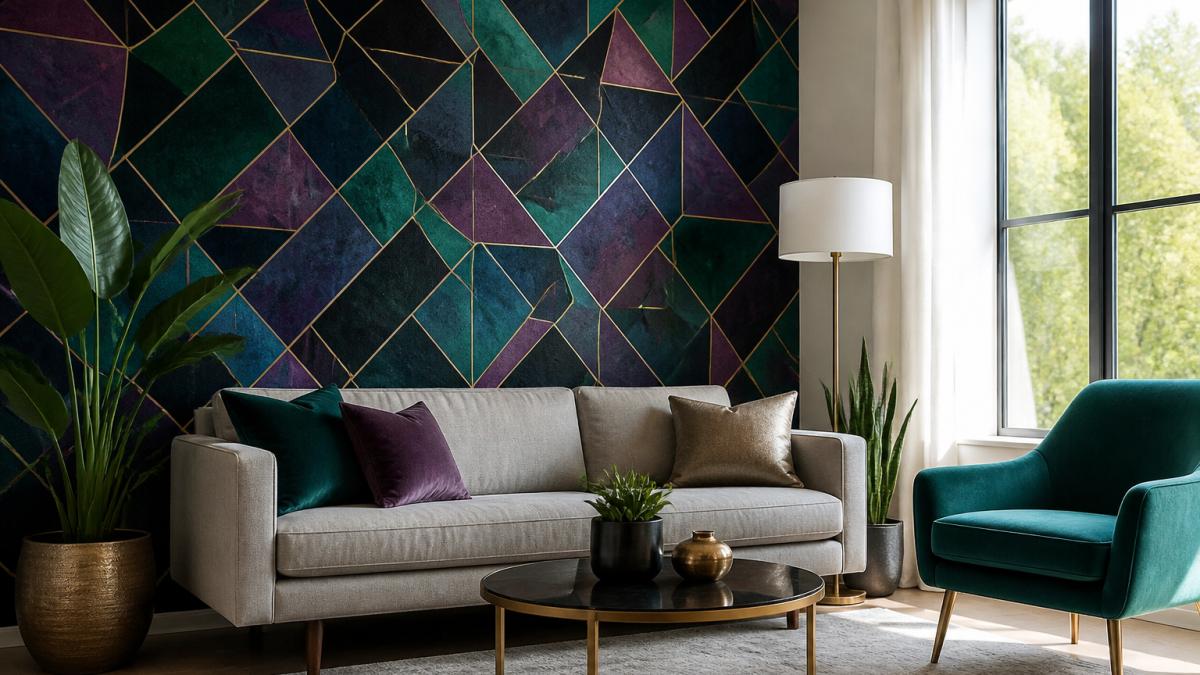
Specific prompts create usable designs. Include style, mood, colors, repeat style, and specific elements. Example: "Seamless repeating pattern of interlocking geometric shapes in jewel tones, emerald, sapphire, and gold. Art Deco style with metallic accents." Generate 3-5 variations and refine based on results.
Exporting and Scaling Your Design
Once you have a pattern you love, you need the right file format and resolution for printing. Most AI pattern generators let you export in multiple sizes and formats.
For wall decor, aim for:
- High resolution (300 DPI minimum for printing)
- Large file size (at least 4000x4000 pixels for wall-scale prints)
- Format options: PNG or TIFF for best quality
Research on AI-generated personalized interiors at scale shows that high-resolution exports are critical for maintaining pattern clarity when scaling up to wall size. A pattern that looks great on your screen at small size can look pixelated when blown up to 3 feet by 4 feet.
Test your export by printing a small sample first. This catches any color shifts or resolution issues before you commit to a full wall print.
How to Choose Unique Wall Art That Matches Your Room
Not every pattern works in every space. The best unique AI graphic patterns for home decor match your room's existing colors, furniture style, and overall vibe.
Color Palettes and Pattern Scale
Pull colors from your largest furniture pieces and existing decor. Large rooms handle bold, large-scale patterns; small rooms need smaller repeats. Test your pattern by previewing it in your actual room before printing.
Mixing Patterns Without Clashing
Mix patterns by varying scale, keeping a shared color palette, and separating by room zone. The safest approach: one patterned wall, solid colors elsewhere.
Room-by-Room Placement for AI-Generated Patterns
Different rooms have different visual demands. Choosing the right pattern for each space requires considering not just style, but scale, color harmony, lighting, and how the pattern will interact with furniture and daily use.
Living Rooms: Making a Bold Statement
Living rooms suit bold statement patterns. Use medium-to-large scale with 12-24 inch repeats. Pull colors from your sofa; if neutral, introduce jewel tones or warm terracottas. Place the pattern on an accent wall behind the sofa or opposite seating. Keep other furniture minimal and neutral.
Bedrooms: Creating Calm and Intimacy
Bedrooms need calming, intimate patterns. Use smaller-to-medium scale (4-12 inch repeats) with soft, muted tones. Avoid high-contrast patterns that interfere with sleep. Place a feature wall behind the bed or a smaller accent wall (4-6 feet). Test patterns under your actual bedroom lighting. Keep the rest of the room simple to prevent sensory overload.
Home Offices: Inspiration Without Distraction
Home offices need patterns that inspire focus. Use geometric designs or structured ornamentals at medium density. Place an accent wall behind or to the side of your desk, avoiding direct line-of-sight for video calls. Use matte finishes to reduce glare.
Kitchens and Dining Areas: Personality With Practicality
Kitchens handle bolder patterns. Use medium-to-large scale geometric or patchwork designs. Place a single accent wall behind the dining table. Use wallpaper or canvas for durability in high-moisture environments.
Entryways and Hallways: Setting the Tone
Entryways and hallways set the tone for your home. Use larger-scale patterns (12-24 inch repeats) with warm, inviting colors. Pattern all walls in hallways or a feature wall in entryways. Test patterns under actual hallway lighting. Use durable methods (wallpaper or canvas) with matte finishes to resist wear.
Smaller Spaces: Scale and Visual Weight
Small spaces need smaller repeats (4-8 inches) and lighter colors with white space to feel larger. Pattern just one wall to avoid overwhelming the space. Use timeless geometric or subtle floral patterns that won't feel dated quickly.
Materials, Printing, and Production Considerations
Your beautiful AI pattern only works if it prints well and lasts. The production method you choose affects not just appearance but durability, cost, and how the pattern will age in your home.
Printing Methods and Their Trade-Offs
Inkjet ($20-$100): affordable but fades in 3-5 years. Giclée ($80-$300+): archival-quality, lasts 50+ years. Wallpaper ($50-$200): seamless, durable 10+ years, requires careful installation. Canvas ($60-$250): textured, gallery feel, forgiving of imperfections. Fabric: dye printing is more durable than heat-transfer for functional items.
Material Choices and Visual Impact
Matte: reduces glare, hides dust, ideal for calm spaces. Glossy: vibrant colors, shows fingerprints, less practical in high-traffic areas. Textured (canvas, linen): adds handmade quality, forgiving of imperfections, may reduce clarity in intricate patterns.
Evaluating Print Quality Before Committing
Check color accuracy, pattern registration at seams, resolution clarity, ink saturation, and material feel.
File Specifications for Production
Your AI-generated pattern needs the right technical specs to print cleanly at scale.
Resolution: Aim for 300 DPI (dots per inch) minimum for any print method. This is the standard for professional printing. At 300 DPI, a 4000×4000 pixel file prints at approximately 13"×13" at full quality. For larger wall prints, you need proportionally larger files. A 24"×36" print at 300 DPI requires a 7200×10800 pixel file.
Color space: Export in RGB for screen-based viewing or CMYK if your printer specifies it. Most online print services accept RGB and convert internally, but confirming with your printer prevents color-shift surprises.
File format: PNG (with transparency) or TIFF (uncompressed) preserve quality best. JPEG uses compression that can introduce artifacts, especially in patterns with fine details or solid color blocks. For wallpaper or fabric, your printer may request specific formats, ask before exporting.
Seamless vs. non-seamless: If your pattern is designed to repeat across a wall, ensure the edges align perfectly. Test this by opening your file in an image editor and tiling it 2×2 to verify no visible seams appear where tiles meet.
Production Timeline and Ordering Considerations
Mass-produced wall art ships in days. Custom AI-generated prints take longer because they're made-to-order.
Typical timelines:
- Standard inkjet prints: 3-7 business days
- Giclée prints: 5-10 business days
- Wallpaper: 7-14 business days (longer if custom sizing)
- Canvas: 5-10 business days
If you're on a deadline, confirm production time before ordering.
Questions to ask your printer:
- What inks do you use, and are they fade-resistant?
- Do you offer proofs or samples before full production?
- Can you print custom sizes, or are you limited to standard dimensions?
Why AI-Generated Patterns Stand Out From Generic Design
The real difference between unique AI graphic patterns for home decor and mass-produced alternatives is intentionality. Mass-produced wall art is designed for everyone, which means it resonates with no one specifically.
AI-generated patterns let you customize. You control the colors, scale, style, and mood. The result feels personal because it is. Your pattern doesn't exist on five other walls in your city.
This matters psychologically. People feel more connected to spaces that reflect their actual taste. A room with custom AI-generated wall art tells visitors something true about you. It's not a compromise between what you wanted and what was available. It's what you actually chose.
The technology also removes gatekeeping. You don't need design training or a huge budget. A clear prompt and a few iterations get you professional-quality patterns. That democratization of design is changing how people think about their homes.
Creating unique wall art for your home doesn't require hiring an expensive designer or settling for generic options. AI pattern generators put genuine creative control in your hands, letting you design custom graphics that match your space perfectly. Popmakesyousmile gives people access to unique, AI-generated designs that feel authentically theirs. Explore custom pattern options and transform your walls into something that actually reflects who you are.
Frequently Asked Questions
What are AI-generated patterns for home decor?
AI-generated patterns are unique decorative designs created by artificial intelligence tools that produce everything from floral repeats to geometric and arabesque motifs. These patterns can be customized through text prompts and applied to wall art, textiles, and home accessories. Unlike mass-produced designs, AI pattern generators let you specify colours, styles, and complexity to match your space perfectly, giving your home decor genuine personality rather than generic stock imagery.
How do I use an AI pattern generator to create wall art?
Start by describing your desired aesthetic in a text prompt, specifying style (floral, geometric, ornamental), colour palette, and mood. The AI pattern generator creates a seamless repeat design you can preview before export. Once satisfied, export at high resolution for sharp, detailed prints. You can then apply the design to canvas, wallpaper, framed prints, or textiles depending on your home decor goals. Iteration is free, so experiment until you find exactly what fits your room.
How do I choose unique wall art that actually suits my room?
Start by assessing your room's existing colour palette, lighting, and furniture style. Choose a pattern scale that complements your wall size: small intricate motifs work in compact spaces, while bold geometric or large floral repeats suit open walls. Consider whether you want the pattern to blend with your decor or serve as a focal point. Test how the pattern looks in your space by viewing high-resolution mockups before committing. Avoid overly trendy styles that may feel dated quickly; instead, select designs that reflect your genuine aesthetic preferences.
Can AI-generated patterns be used on different home decor products?
Yes. AI graphic patterns work across wall art, textiles, cushions, wallpaper, rugs, decorative panels, and even furniture surfaces. The key is ensuring the design exports at sufficient resolution for your chosen medium. Wall art typically needs high-resolution files for crisp detail, while textiles benefit from seamless repeat patterns that tile smoothly. Made-to-order production networks can apply your AI-generated pattern to virtually any home decor product, giving you complete control over how your unique design appears in your space.