 ultimate-guide
Are AI-Generated Designs Original? A 2026 Guide
Table of Contents
- What Does "Original" Actually Mean for AI-Generated Designs?
- How AI Image Generation Works (and Why It Matters for Originality)
- AI Art and Copyright: What the Law Says in 2026
- AI-Generated Designs and Ownership: Who Actually Holds the Rights?
- How to Identify AI-Generated Artwork (Without Guessing)
- Ethical Use of AI-Generated Designs: Disclosure, Similarity Checks, and Commercial Sales
- Conclusion: Originality Is a Spectrum, Not a Switch
- Frequently Asked Questions
Last Updated: October 14, 2026
What Does "Original" Actually Mean for AI-Generated Designs?
Whether AI-generated designs are original has no single answer: copyright requires human authorship, while artistic originality only needs a spark of personal expression. AI-generated designs clear the second bar more easily than the first.
That gap between legal and artistic originality is where nearly every argument about AI art lives. At Popmakesyousmile, we build every design with AI tools.
Here is the practical version: an AI-generated design is original when a human makes meaningful creative choices about what the tool produces and how it is used.
The Two Tests: Human Contribution and Training Data
Originality in AI-generated work gets judged against two separate tests, and designs usually pass one while failing the other.
The human contribution test asks how much creative decision-making a person brought to the output. Prompts, iteration, editing, composition choices and final selection all count. A Design Research Society case study on designer-AI co-creation describes AI image generation as a tool for the conceptualization phase of design work, which frames the human as the director rather than a passive button-presser.
The training data test asks a harder question: where did the model learn its visual patterns? The University of Plymouth's examination of whether AI-generated art is actually art makes exactly this point, and the Harvard Gazette's skeptical take on AI originality argues that imitating something already created and regurgitating it in a new format does not amount to an original work.
Both critiques are fair. Neither settles the question for every design.
How AI Image Generation Works (and Why It Matters for Originality)
AI image generation learns statistical patterns from large collections of training images, then produces new pixel arrangements matching a text prompt. The output is new at the pixel level, but assembled from learned patterns rather than lived experience.
That explains why AI designs can look striking and slightly hollow at once: the model absorbed composition rules, color relationships, and object placement conventions from millions of images, but not feelings, memories, or a point of view.
Machine learning generalizes rather than copy-pasting. Ask for a cat in a hat and you get a cat that never existed, in a style inferred from many artists' work.
Most working designers land somewhere practical: the tool generates, the human curates. That curation is where the creative process actually happens.
AI Art and Copyright: What the Law Says in 2026
Copyright protection generally requires human authorship, and purely AI-generated output has struggled to meet that bar in most major jurisdictions. A design generated with no meaningful human input may have no enforceable copyright at all. That does not make AI-generated designs illegal or unusable, it means the ownership picture is thinner than most buyers assume.
Where human input is substantial, selection, arrangement, and modification of AI output can attract protection in some systems, though boundaries vary by country. The U.S. Copyright Office says works lacking human authorship are not copyrightable, while works combining human authorship with AI-generated material may be protected only for the human-authored portions. Confirm copyright with a qualified professional for your jurisdiction.
The Three Legal Questions People Confuse
Most arguments about AI and copyright collapse three separate questions into one. Keeping them apart makes the issue easier to reason about.
Copyrightability asks whether the work can be protected at all. A raw generation with a one-line prompt usually fails; a design where a human selected, arranged, and substantially edited the output has a stronger claim.
Ownership asks who holds whatever rights exist, depending on the tool's terms of service, your contracts, and the jurisdiction. Most commercial image generators grant broad rights to outputs, but details vary and some restrict commercial use on free tiers.
Training-data implications ask whether the model's use of source images creates separate risk.
A Practical Provenance Workflow
Originality claims are only as strong as the evidence behind them.
**1.
2. Record selection and rejection. Note which outputs you rejected and why. Curation is a creative act, and showing judgment strengthens the human-authorship story.
3. Log edits and compositing. Keep layered files, adjustment history, and notes on what you changed after generation.
4. Run a similarity check before commercial use. Use reverse image search and compare your output against existing artwork in the same style or category.
5. Check the tool's commercial terms. Confirm your plan permits commercial use and that you understand any restrictions on resale, licensing, or client work.
6. Disclose the AI role to clients and buyers. If a design is AI-generated, say so.
What This Means for Commercial Sellers
If you sell physical products with AI-generated graphics, your customer is buying the object, not a licence to the artwork, be clear about what they can and cannot do with the design. For client work, put the AI role and scope of rights in writing before delivery. For marketplaces and print-on-demand platforms, check their AI disclosure rules, which often add requirements beyond copyright law.
The safest commercial posture is not to claim AI-generated designs are fully original in the legal sense, but to show a human made meaningful creative choices, the output was checked against existing work, and buyers know what they are getting. That turns a generated image into a defensible product.
AI-Generated Designs and Ownership: Who Actually Holds the Rights?
Ownership of AI-generated designs depends on three things: the AI tool's terms, the amount of human creative input, and your jurisdiction. Get any one wrong and you can end up selling something you do not control.
Start with the tool's terms of service. Most commercial image generators grant users broad rights to their outputs, but details vary, and some restrict commercial use on free tiers.
Next, document the human layer. A design that started as a rough prompt and ended as a finished, edited, composed graphic carries a stronger ownership story than a one-line prompt with no follow-up.
Finally, accept that ownership and originality are not the same thing. You can own a derivative design, or create something original with no clear legal claim to it.
How Much Human Input Changes the Ownership Story
Not all AI-assisted workflows are equal: the level of human contribution affects how original a design feels and how defensible your rights are.
Prompt-only generation. You type a prompt, take the first output, and use it. Human input is minimal.
Prompt plus selection. You generate many options and choose one. Curation is a creative act, but the underlying expression still comes mostly from the model, so ownership claims are stronger than prompt-only but still thin.
Prompt plus iteration and editing. You refine the prompt across multiple rounds, then edit the output in an image editor.
Compositing and substantial transformation. You combine multiple generated elements, add original illustration or typography, and build a layered composition. This is the strongest position.
Client Disclosure and Commercial Use
If you use AI-generated assets in paid work, disclosure is not just ethical. It is risk management. Clients increasingly ask how a design was made, and platforms often require AI disclosure. A short, plain statement in your contract or project brief prevents surprises later.
A practical disclosure line might say the design was created using AI generation tools under human direction, with selection, editing, and final composition performed by the designer. That sentence is honest, documents the human role, and sets expectations.
For commercial sales, separate the product from the artwork: a customer buying a printed shirt is buying the shirt, not a licence to reproduce the design.
Before delivering any AI-assisted design to a client, save a one-page process note: the tool used, the prompt direction, the number of iterations, the edits made, and the similarity check performed. It takes five minutes and it answers most ownership questions before they become disputes.
What to Do If You Are Unsure
If you cannot confirm you hold the rights you need, do not sell the design as if you do. Strengthen the human contribution until the ownership story is clear, replace the asset with one you can document, or get professional advice for your jurisdiction. A short legal consultation almost always costs less than a takedown, refund, or rights dispute.
How to Identify AI-Generated Artwork (Without Guessing)
Identifying AI-generated artwork comes down to fine details: line patterns, object placement, and anatomical accuracy. Modern generators handle the big picture well, so the tells now live in the small stuff.
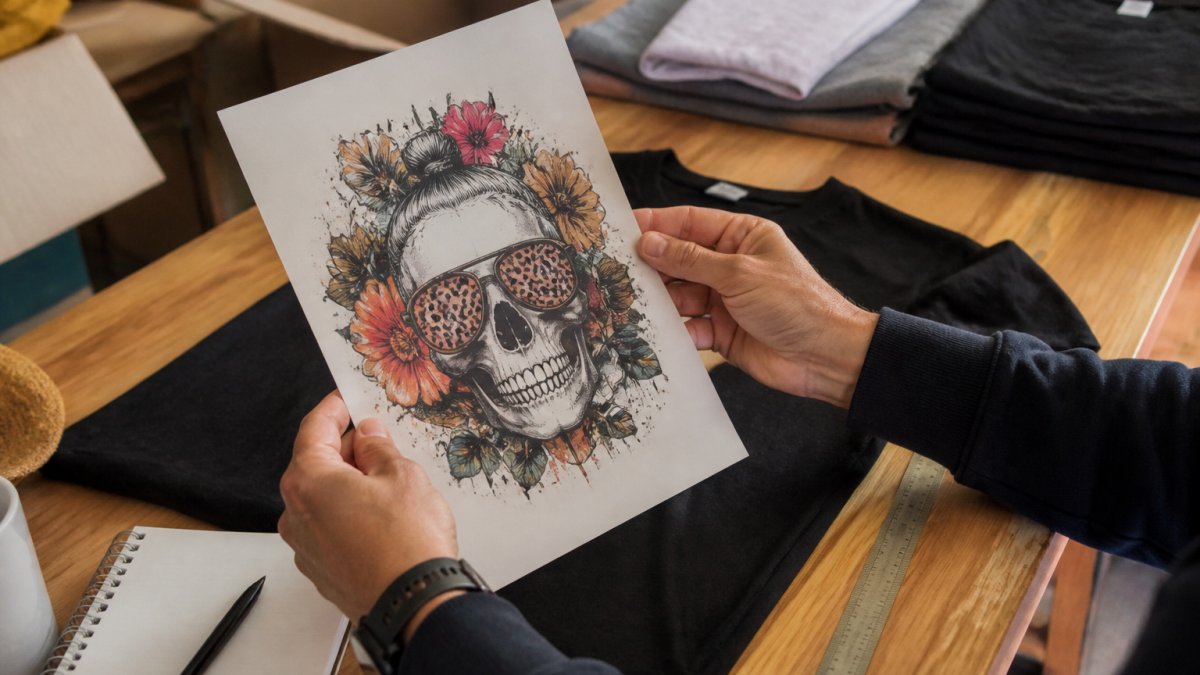
Common visual errors to check for:
- Hands and fingers: extra digits, merged fingers, or unnatural joint angles
- Text: garbled lettering, invented characters, or inconsistent fonts within one design
- Backgrounds: objects that blend into each other or repeat in impossible ways
- Jewelry and straps: necklaces that dissolve into skin, bag straps that go nowhere
- Symmetry: reflections and shadows that do not match their source object
A peer-reviewed study on how people interpret AI-generated versus human-made images found that human-made images were more readily recognized as human-made, while AI-generated images were frequently misclassified as human-made. In other words, readers are not reliable detectors. Look at the details, not your gut.
Zoom to 200% on any suspicious design and check the hands, ears, and any background text first. Those three zones account for most visible AI errors, and they take about ten seconds to inspect.
Ethical Use of AI-Generated Designs: Disclosure, Similarity Checks, and Commercial Sales
Disclosure is the easy one. If a design is AI-generated, say so. Buyers increasingly ask, and hiding it invites the exact accusation you are trying to avoid.
Similarity checks are the one most sellers skip. Before selling commercially, run a reverse image search and compare your output against existing artwork in the same style or category.
Commercial sales add a third layer: if you sell physical products with AI-generated graphics, your customer is buying the object, not a licence to the artwork.
At Popmakesyousmile, every product is made to order through a professional production network, and our designs are created with AI tools and then selected and refined by a human eye.
Conclusion: Originality Is a Spectrum, Not a Switch
Treating originality as a binary is the fastest way to get this wrong. AI-generated designs sit on a spectrum, and where one lands depends on how much human judgment went into it, what the model learned from, and how honestly it is presented to buyers.
If you are shopping for a gift with actual personality, that spectrum is good news. The designs worth buying are the ones a human chose, refined, and stood behind, not the ones a prompt spat out in ten seconds. Popmakesyousmile exists for exactly that: unique, statement-making designs on apparel, mugs, hoodies, and home decor, all made to order and picked by a person with a sense of humor.
Browse the collection and find something that sounds like you, not like everyone else's prompt history.
Frequently Asked Questions
Are AI-generated designs copyrighted?
In most jurisdictions, including the US and UK, purely AI-generated work without meaningful human input cannot be copyrighted because copyright law requires a human author. If a designer significantly edits, arranges, or builds on the AI output, that human contribution may qualify for protection. The rules are still evolving in 2026, so check your local copyright office before assuming you own a purely machine-generated image.
What makes an AI-generated design original?
A design is generally considered original when it reflects meaningful human contribution: a specific creative brief, deliberate prompt engineering, iterative editing, and a final composition that did not exist before.
How can you tell whether a design was generated by AI?
Look for anatomical inaccuracies in hands, ears, or eyes, odd object placement, and line patterns that break or merge unnaturally. Text is often garbled, and shadows may not match the light source. Provenance tools and metadata checks give stronger evidence.
Can you sell products featuring AI-generated designs?
Yes, but with caveats. You need to confirm the AI tool's commercial-use terms, avoid designs that closely replicate existing copyrighted artwork, and be transparent with buyers if disclosure is required in your market. Always run a similarity check before listing.