 listicle
Best Print on Demand Alternatives 2026: 9 Picks Ranked
Table of Contents
- Why Sellers Are Hunting for Print on Demand Alternatives in 2026
- Print on Demand Alternatives Compared: Catalog, Fulfillment, and Cost
- The Best Print-on-Demand Sites for Beginners
- Redbubble Alternatives for Artists Who Want More Control
- Free Print-on-Demand Websites: What You Actually Get
- Non-Clothing Print-on-Demand Suppliers for Home Decor and Gifts
- How to Choose: Match the Platform to Your Business Stage
- Frequently Asked Questions
Last Updated: October 19, 2026
Why Sellers Are Hunting for Print on Demand Alternatives in 2026
The print-on-demand market is projected to grow from $16.44 billion in 2026 to $118.85 billion by 2035, at roughly 25% annually, according to Printful's 2026 print-on-demand statistics.
The wall usually looks like thin margins, a catalog that stops at t-shirts, or a provider that quietly swaps a blank.
Here is what most guides get wrong: "alternatives" is not one list. Two different searches hide behind the phrase, and mixing them up wastes money.
Print on Demand Alternatives Compared: Catalog, Fulfillment, and Cost
A POD provider is a fulfillment partner: you run your own store and set retail prices while the provider prints and ships. A POD marketplace is a storefront: you upload art, they handle the store, customer, and pricing, and you take a royalty.
Customily notes there is no single best print-on-demand company for every seller; the right pick depends on business model, target market, and customization needs (Customily's 2026 POD comparison).
| Platform | Type | Best For | Watch Out For |
|---|---|---|---|
| Popmakesyousmile | Made-to-order gift shop | Humorous, expressive gifts across apparel and home | Curated catalog, not a blank canvas |
| Printify | Provider network | Comparing providers and testing products | Consistency varies by provider |
| Gelato | Global provider | Local production near the buyer | Pricing needs a direct quote |
| Gooten | Provider | Custom homeware | Verify automation details yourself |
| CustomCat | Provider | US apparel, value focus | US-centric fulfillment |
| Apliiq | Provider | Branded apparel detail | Limited public specs |
| Spreadshirt | Marketplace + provider | Beginners wanting a storefront | Less control over margins |
| Teelaunch | Provider | Simple product range | Smaller catalog |
| Society6 | Marketplace | Artists wanting zero setup | Lowest control per sale |
The Best Print-on-Demand Sites for Beginners
For a first store, the best print-on-demand site removes setup friction, not catalog size. Beginners lose money on decisions, not blanks, so pick a platform where the default path is hard to get wrong, then verify with a sample order before spending on ads.
There are three beginner paths, and they fail in different ways:
- Marketplace storefront (Spreadshirt, Society6, Redbubble-style). You upload art, the platform runs the store, sets or suggests pricing, handles the customer, and pays you a royalty. Setup time is measured in hours. The failure mode is margin: you do not control retail price, you do not own the customer email, and your royalty is a fraction of the sale.
- Provider + your own store (Printify, Gelato, Gooten, Teelaunch, CustomCat). You connect a store builder, set retail prices, and the provider prints and ships per order. Setup time is measured in days. The failure mode is operational: you now own marketing, customer service, and the returns policy.
- Curated made-to-order shop (Popmakesyousmile-style). You sell a designed catalog rather than blank canvases, so the product decision is partly made for you. Setup is fast, but the catalog is curated, it is not a blank canvas for any design you want.
Spreadshirt and Teelaunch both appear in beginner-focused POD roundups and in 2026 lists of platform alternatives (Printify's 2026 POD statistics).
The beginner cost math most guides skip
A beginner's real cost per order is product cost + shipping + platform or store fee + payment processing + ad spend per order. A common pattern: a seller prices a tee at a healthy markup over the blank, then discovers shipping and payment fees eat the difference and modest ad costs turn the order into a loss.
Run this before you launch:
- Write down the all-in cost per unit (product + shipping to your target region).
- Add your store platform fee and payment processing percentage.
- Set a retail price and subtract, that is your gross margin per order.
- Divide your monthly fixed costs by that margin to get your break-even order count.
- Only then decide whether paid ads are viable, or whether you need organic/marketplace traffic first.
If the break-even count looks unreachable at your traffic level, the problem is the model, not the platform, consider a marketplace (lower margin, traffic included) or a curated catalog with stronger perceived value.
The sample-order protocol
Order one unit of your three best-selling designs before spending a cent on ads. Print quality, color accuracy, and packaging generate refunds, and none show up in a mockup.
- Order a sample of every product type you plan to sell
- Wash a shirt three times before judging print durability
- Photograph the real product for your listing
Redbubble Alternatives for Artists Who Want More Control
Artists leave marketplaces for one reason: control. On a marketplace you do not set retail price, own the customer, or decide which products carry your work.
The first camp is a provider plus your own store: you set prices, keep the customer relationship, and control the catalog, but you handle marketing, customer service, and returns.
Gelato and Gooten both appear in 2026 comparisons alongside Printify and Printful, with Gooten specifically highlighted for custom homeware (Reddit's 2026 POD company discussion).
Free Print-on-Demand Websites: What You Actually Get
Free print-on-demand websites are real, but "free" refers to the platform fee, not the cost of doing business.
The free tier typically gives you a storefront, product catalog, order routing, and basic integration, but withholds white-label branding, discounted pricing, bulk fulfillment, and priority support.
That trade-off is fine at low volume and painful at scale.
- Free tier is best for: testing a niche before committing
- Paid tier is best for: white-label packaging and lower unit cost
- Watch for: per-order fees that quietly replace the subscription
The calculation is simple. Multiply your monthly order volume by the per-unit difference between free and paid pricing. If that number exceeds the subscription cost, upgrade.
Non-Clothing Print-on-Demand Suppliers for Home Decor and Gifts
Apparel gets the attention, but margin and differentiation usually live outside it. Non-clothing print-on-demand suppliers cover mugs, canvas prints, throw pillows, blankets, phone cases, and home decor, where gift-focused sellers compete.

Gooten comes up most often for custom homeware in 2026 comparisons, and Society6 built its business on art-led home products.
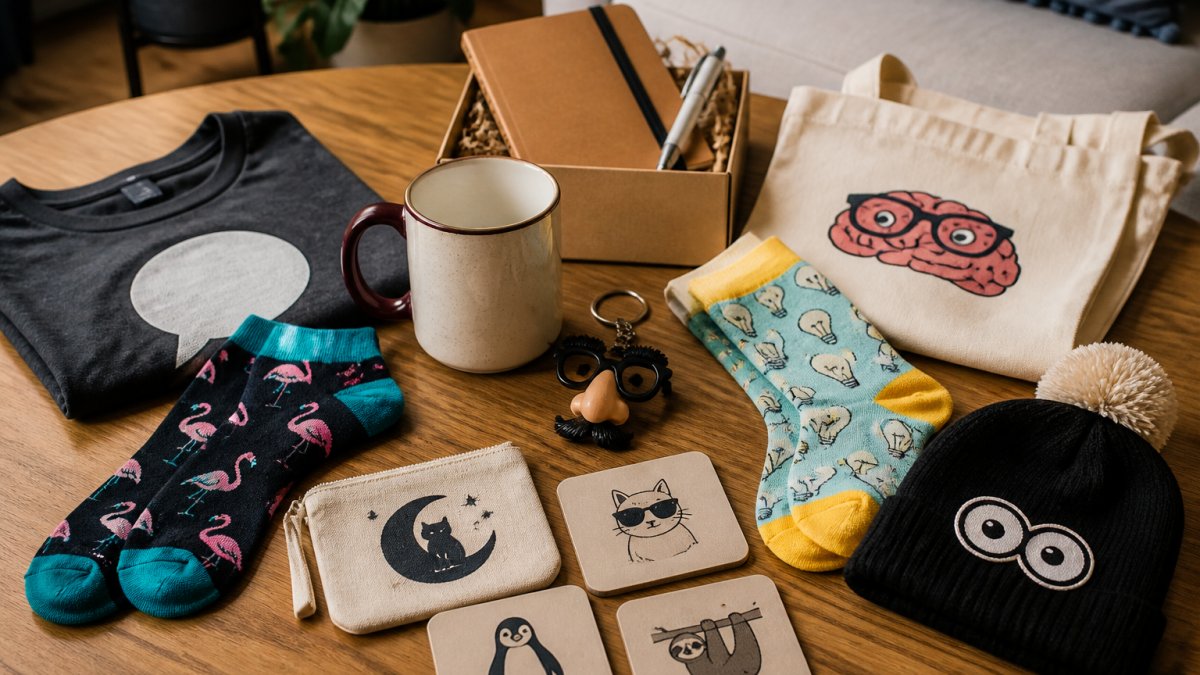
This is the category Popmakesyousmile operates in.
How to Choose: Match the Platform to Your Business Stage
Match the platform to your stage, not a ranking. A provider wrong for a beginner is often right at 500 orders a month, and the reverse holds too. Below: a decision matrix, a cost model, and the operational questions that decide whether a switch pays.
The decision matrix
| Your situation | Order volume | Risk tolerance | Best-fit model | Why |
|---|---|---|---|---|
| Testing a niche | 0-50/month | Low | Marketplace or free provider tier | No subscription, traffic included, fast proof of demand |
| Validated demand | 50-300/month | Medium | Provider + own store | You control price, branding, and customer data |
| Scaling | 300+/month | Medium-High | Provider network or hybrid (POD + bulk for top sellers) | Network breadth absorbs demand spikes; bulk cuts unit cost on proven designs |
| High-touch gift brand | Any | Low-Medium | Curated made-to-order catalog | Perceived value supports margin without inventory risk |
| Price-sensitive commodity | 300+/month | High | Bulk inventory + local fulfillment | Lowest unit cost, but capital and dead-stock risk |
"Best" depends on volume, risk tolerance, and whether you are buying traffic or building it.
A comparable cost model
Provider spec sheets quote different things, so build your own model on one consistent example order, a single apparel item shipped to one target region, and fill in every line:
- Product cost (the blank + print).
- Shipping to your actual buyer region, not the provider's cheapest zone.
- Platform or store fee (subscription amortized per order, or per-order fee).
- Payment processing (a percentage plus a fixed per-transaction amount).
- Customization or personalization fee, if your product uses it.
- Likely selling price at your positioning.
- Gross margin per order = selling price minus lines 1-5.
Then compare models on the same order: a marketplace royalty and a provider-plus-store margin are not the same number, and a lower blank price can lose on shipping to your region. Run it twice, current volume and 3x, because subscriptions amortize and per-order fees do not.
Returns, damaged orders, and who owns the customer
- Who refunds a damaged item? Confirm in writing whether the provider or you absorb the cost, and whether a photo is required.
- Who pays return shipping? On made-to-order items, many providers do not accept returns for buyer's remorse, only for defects. Know which you are offering before you publish a policy.
- How long does a replacement take? A slow replacement turns a defect into a chargeback.
- Who owns the customer relationship? On a marketplace, the platform does. On your own store, you do, which is an asset, but also a support obligation.
A provider with a slightly higher unit cost and a clear damage policy is usually cheaper overall than a cheaper provider with an ambiguous one.
The migration cost nobody budgets for
Switching platforms is not free even when the new platform is. Budget for:
- Re-uploading and re-linking every design and product variant.
- Re-ordering samples, because print output differs by provider.
- Re-testing checkout, taxes, and shipping rates.
- Rewriting product descriptions and policies to match the new fulfillment terms.
A common pattern: a seller switches to save a little per unit, spends a month re-linking products, and loses more in stalled sales than the savings return. Switch only when the cost model shows a clear margin gain at your volume, not because a ranking changed.
The market data backs the caution. Around 40% of active print-on-demand sellers list products on Etsy, which means most of your competitors are on a marketplace and competing on the same search results (Wix's 2026 print-on-demand trends).
Frequently Asked Questions
What are the best print on demand alternatives in 2026?
There is no single winner. The 2026 comparisons point to Printify for provider choice and product variety, Gelato and Gooten for broader fulfillment needs, CustomCat for US apparel value, and marketplace-style sites like Society6 for artists who want built-in traffic. The right pick depends on your business model, target market, and how much customization you need. Test two providers with sample orders before committing your catalog.
Which print-on-demand sites are best for beginners?
Beginners benefit most from platforms with simple store setup, no upfront subscription, and a wide product catalog. Spreadshirt, Teelaunch, and Society6 all appear in 2026 beginner-focused lists. Look for clear production times, sample ordering, and responsive customer support before you upload designs. Starting with a small batch of products on one platform beats spreading thin across five.
Are there free print-on-demand websites?
Most POD platforms charge no monthly fee to open an account and instead take a cut of each sale or build costs into the base price. That makes them effectively free to start, though you pay per order. Marketplace models like Society6 and Spreadshirt handle printing and shipping for you. Check current fee structures directly, since terms change and the research does not verify specific plan pricing.
Which print-on-demand companies offer products beyond clothing?
Gooten is specifically highlighted in 2026 comparisons for custom homeware. Printify's catalog covers over 1,300 products across 80+ print providers, which includes mugs, wall art, and accessories. Gelato also appears in broader fulfillment comparisons. If gifts and home decor are your focus, prioritize providers with strong non-apparel catalogs and order samples of mugs or prints before scaling.